
AI Infrastructure Investment: 12 Best Ultimate Strategies for 2025
Discover AI infrastructure investment strategies for fiber networks and data centers. Expert insights on securing your technological future with smart decisions.
 Ryan Thompson
Introduction
Key Takeaways
- Strategic fiber network investments are foundational to unlocking AI's transformative potential across industries
- The AI infrastructure landscape is experiencing unprecedented growth, with technology leaders planning massive capital commitments
- Understanding the synergy between connectivity infrastructure and AI capabilities is essential for securing long-term technological advantages
- Professional expertise in cloud computing and data networks reveals critical investment strategies that future-proof AI deployments
- Robust fiber networks serve as the essential backbone enabling AI systems to process and analyze data at scale
A few years ago, I witnessed firsthand how fiber networks would become the critical foundation for AI's widespread adoption. With my background in data networks and cloud computing, I recognized that AI's true power would only emerge through robust, reliable connectivity. This realization shaped my approach to AI infrastructure investment—understanding that fiber networks are the veins through which data flows seamlessly, enabling unprecedented processing speeds.
Today's AI infrastructure landscape reflects this fundamental truth. Technology giants are committing extraordinary resources to build the connectivity backbone that AI demands. Recent industry analysis shows that U.S. technology leaders plan to invest over $650 billion in AI infrastructure by 2026, with top hyperscalers collectively planning over $500 billion in infrastructure investments. These figures underscore a pivotal shift: AI-ready infrastructure is now viewed as a strategic asset, comparable to energy or transportation systems in its fundamental importance.
The relationship between fiber networks and artificial intelligence represents more than a technical requirement—it's a strategic imperative. As AI applications grow more sophisticated and data-intensive, the underlying network infrastructure must evolve to support real-time processing, massive data transfers, and distributed computing architectures. Organizations that understand this connection and invest strategically in fiber-based infrastructure position themselves to capitalize on AI's transformative capabilities.
This guide explores the critical dimensions of AI infrastructure investment, from understanding market dynamics to evaluating technical specifications and financial metrics. Whether you're a technology leader, infrastructure investor, or strategic decision-maker, the insights ahead will help you navigate the complex landscape of fiber network investments that enable AI's future. The convergence of telecommunications and artificial intelligence creates unprecedented opportunities for those prepared to invest wisely in the foundational infrastructure that powers innovation.
Sources
- 2026 AI Investment Guide: From Infrastructure Boom to Revenue Reality
- U.S. Technology Investment Analysis
Discover AI infrastructure investment strategies for fiber networks. Expert insights on securing your technological future with smart decisions.
Focus keyword: AI infrastructure investmentTone: professional
Table of Contents
- Introduction — Hook readers with Ryan's personal story about recognizing the critical connection between fiber networks and AI infrastructure. Establish credibility through his background in cloud computing and data networks. Frame the article's promise: understanding how strategic fiber network investments enable AI's transformative potential and secure long-term technological advantages.
- Table of Contents — Auto-generated navigation for all sections
- Why Fiber Networks Are Critical for AI Infrastructure — Explain the fundamental relationship between high-bandwidth fiber networks and AI performance. Cover latency requirements, data throughput demands, and how fiber's physical properties enable real-time AI processing. Discuss the symbiotic relationship between AI advancement and network capacity that Ryan discovered during his investment journey.
- The Current Market Landscape and Growth Drivers — Analyze the present state of fiber network infrastructure supporting AI. Examine market trends, demand acceleration from cloud AI applications, edge computing requirements, and the telecom sector's evolution. Include discussion of bandwidth consumption patterns and infrastructure gaps creating investment opportunities.
- Network Investment Strategies for AI-Ready Infrastructure — Detail strategic approaches to fiber network investments that prioritize AI infrastructure needs. Cover scalability planning, future-proofing considerations, geographic positioning, and capacity planning. Explain how to evaluate network assets based on AI workload requirements and long-term technological evolution.
- Technical Requirements and Specifications to Consider — Break down the technical specifications investors should understand: fiber types, bandwidth capabilities, latency thresholds, redundancy requirements, and interconnection standards. Translate technical jargon into accessible investment criteria that align with AI infrastructure demands.
- Evaluating ROI and Financial Metrics — Provide framework for assessing financial returns on fiber network investments. Discuss revenue models, cost structures, depreciation timelines, and how AI demand impacts valuation. Cover both immediate returns and long-term value appreciation as AI adoption accelerates.
- Risk Assessment and Mitigation Strategies — Identify key risks in fiber network investments for AI infrastructure: technological obsolescence, regulatory changes, competitive pressures, and market saturation. Offer practical mitigation strategies based on diversification, timing, and partnership approaches that Ryan learned through experience.
- Partnership and Collaboration Models — Explore different investment structures: direct ownership, joint ventures, public-private partnerships, and consortium approaches. Discuss how collaboration between telecom providers, cloud platforms, and AI developers creates synergistic value and reduces individual risk exposure.
- Future Trends and Emerging Opportunities — Look ahead at emerging technologies and market shifts: quantum networking potential, edge AI requirements, 6G development, and evolving data center architectures. Help investors position their fiber network holdings to capitalize on next-generation AI infrastructure needs.
- Conclusion — Reinforce the strategic importance of fiber network investments in the AI era. Summarize key investment principles and strategies. End with Ryan's perspective on how these infrastructure investments support technological evolution and create lasting value. Include clear call-to-action encouraging readers to evaluate their own investment strategies.
11 sections
Why Fiber Networks Are Critical for AI Infrastructure
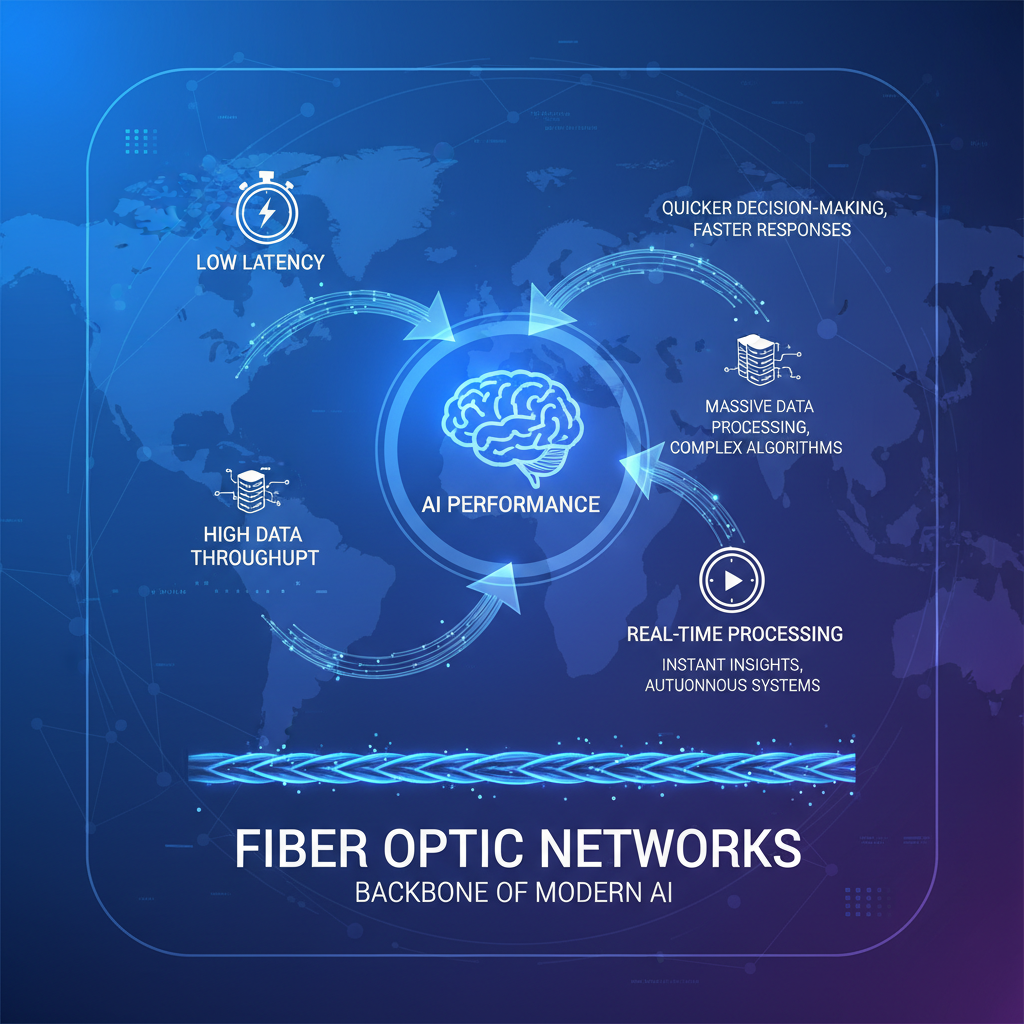
The relationship between fiber networks and AI performance represents one of the most critical dependencies in modern technology infrastructure. As AI systems evolve from experimental applications to production workloads that process massive datasets in real time, the underlying network infrastructure must deliver unprecedented levels of bandwidth, minimal latency, and unwavering reliability. Traditional data centers and network architectures simply weren't designed with these demanding specifications in mind.
Fiber optic technology stands alone in its ability to meet the technical requirements that AI workloads demand. The physical properties of fiber—transmitting data as pulses of light through glass strands—enable data throughput that copper-based alternatives cannot match. This becomes essential when AI models need to process terabytes of training data or deliver real-time inference results across distributed computing environments.
The Bandwidth Imperative for AI Workloads
AI applications consume network resources at scales that dwarf traditional enterprise workloads. Machine learning models require constant data flow between storage systems, processing nodes, and end users. Training large language models or computer vision systems involves moving enormous datasets across the network infrastructure repeatedly. Fiber networks provide the high-bandwidth corridors necessary to prevent data movement from becoming a bottleneck in AI operations.
The symbiotic relationship between AI advancement and network capacity creates a reinforcing cycle. As AI capabilities expand, they demand greater network performance. This drives investment in fiber infrastructure, which in turn enables even more sophisticated AI applications. Organizations that recognize this interdependence position themselves to capitalize on both technological trends simultaneously.
Latency Requirements and Real-Time Processing
Beyond raw bandwidth, latency represents a critical performance metric for AI systems. Applications requiring real-time decision-making—from autonomous systems to financial trading algorithms—cannot tolerate delays measured even in milliseconds. Fiber networks minimize latency through direct optical transmission, reducing the signal degradation and processing delays inherent in other transmission media.
The current state of infrastructure may create barriers for enterprises, as traditional data centers are not designed for the technical specifications required by AI workloads. This infrastructure mismatch highlights why strategic investment in fiber networks becomes essential rather than optional. Organizations must upgrade their foundational connectivity to support the AI-driven applications that will define competitive advantage in coming years.
The Economics of AI Infrastructure Investment
While AI infrastructure is a critical bottleneck, with demand for computing power leading to increased data-center construction and long-term capacity commitments, the economics are becoming more favorable. Inference costs have plummeted, dropping significantly over the last two years, yet overall AI spending is experiencing explosive growth. This apparent contradiction reflects the massive scaling of AI deployments across industries.
Fiber networks serve as the connective tissue that makes this scaling possible. Without adequate fiber capacity linking data centers, edge computing locations, and end users, the economic benefits of reduced inference costs cannot be fully realized. Investment in fiber infrastructure thus becomes a strategic enabler of broader AI adoption and value creation.
Future-Proofing Through Fiber Investment
The longevity of fiber optic infrastructure provides another compelling investment rationale. Unlike computing hardware that becomes obsolete within years, properly installed fiber networks can serve enterprises for decades. As AI models grow more sophisticated and data-intensive, the same fiber infrastructure can be upgraded with newer transmission equipment to deliver higher performance without replacing the physical cabling.
This future-proofing characteristic makes fiber network investment particularly attractive for organizations planning long-term AI strategies. The foundational infrastructure installed today will support not just current AI applications, but also the next generation of capabilities that haven't yet been conceived. This positions fiber as both an enabling technology and a strategic asset that appreciates in value as AI adoption accelerates.
Sources
The Current Market Landscape and Growth Drivers

The AI infrastructure investment landscape is experiencing unprecedented momentum as we move through 2025. Technology giants are committing extraordinary capital to build the foundational networks and computing resources that will power the next generation of artificial intelligence applications. The scale of this buildout reflects a fundamental shift in how organizations view infrastructure—not as a cost center, but as a strategic enabler of competitive advantage.
U.S. technology companies plan to invest over $650 billion in AI infrastructure by 2026, representing the most aggressive expansion cycle in the sector's history. This investment wave extends far beyond data centers and processors to encompass the fiber network backbone that connects these resources. The demand for high-bandwidth, low-latency connectivity has created significant opportunities for infrastructure investors who understand the symbiotic relationship between AI advancement and network capacity.
Investment Acceleration Across Major Players
The competitive dynamics among technology leaders are driving capital expenditure to new heights. One major tech company's capital expenditure is expected to surge from $70-72 billion in 2025 to $115-135 billion in 2026, marking the most aggressive AI infrastructure expansion among major technology firms. This level of investment signals a long-term commitment to building proprietary infrastructure that can support increasingly sophisticated AI workloads.
Hardware manufacturers are also experiencing explosive growth driven by this infrastructure boom. Leading data center revenue reached $35.6 billion, up 93% year-over-year, highlighting the growing demand for AI infrastructure components. This revenue growth underscores the real-world deployment of AI systems at scale, moving beyond pilot projects to production environments that require robust, reliable connectivity.
Geographic Distribution and Market Leadership
The global AI infrastructure buildout is not evenly distributed. The U.S. leads globally in terms of AI infrastructure build-out and planned investments, followed by other major technology markets, with some regions lagging behind. This geographic concentration creates both opportunities and challenges for network investors. Areas with dense AI infrastructure deployments require massive fiber capacity, while underserved regions present greenfield opportunities for strategic network expansion.
The telecom sector is evolving rapidly to meet these demands. Traditional network operators are partnering with cloud providers and AI companies to ensure their infrastructure can handle the bandwidth consumption patterns of modern AI applications. Edge computing requirements are driving fiber deployment closer to end users, creating new investment opportunities in metro and access networks that complement long-haul capacity.
Infrastructure Gaps as Investment Opportunities
Despite the massive capital being deployed, significant infrastructure gaps remain. Many existing fiber networks were designed for previous-generation applications and lack the capacity or latency characteristics required for real-time AI processing. These gaps create opportunities for targeted investments in network upgrades, route diversity, and specialized infrastructure that serves AI-specific use cases.
Bandwidth consumption patterns are shifting as AI workloads generate and process exponentially more data. Model training requires sustained high-throughput connections between distributed computing resources, while inference applications demand ultra-low latency for real-time decision-making. Understanding these distinct requirements helps investors identify which network assets will command premium valuations as AI adoption accelerates.
The current market landscape reflects a transition from speculative infrastructure buildout to measurable deployment of AI applications at scale. For investors with expertise in both technology and infrastructure, this environment offers compelling opportunities to support the foundational networks that will enable the next decade of AI innovation.
Sources
Network Investment Strategies for AI-Ready Infrastructure

Investing in fiber networks to support AI infrastructure requires a fundamentally different approach than traditional telecom investments. The experimental nature of AI deployments and their delayed return timelines demand strategies that balance immediate capacity needs with long-term technological evolution. Understanding how to position network assets for AI workloads while maintaining financial discipline separates successful infrastructure investments from those that miss the mark.
The shift toward viewing AI-ready infrastructure as strategic assets—comparable to energy or transportation networks—reflects the critical role connectivity plays in the AI ecosystem. This perspective changes how investors evaluate opportunities, moving beyond simple bandwidth metrics to consider the entire value chain that enables AI processing.
Prioritizing Scalability and Future-Proofing
Scalability planning begins with recognizing that AI workloads grow exponentially, not linearly. Network investments must accommodate rapid capacity expansion without requiring complete infrastructure overhauls. This means selecting fiber assets with dark fiber availability, modular upgrade paths, and room for additional equipment deployment.
Future-proofing considerations extend beyond current AI requirements to anticipate next-generation demands. Investors should evaluate whether network architecture can support emerging technologies without fundamental redesign. The goal is building infrastructure that remains relevant as AI models become more sophisticated and data-intensive.
Capacity planning for AI infrastructure differs from traditional approaches because AI applications generate sustained, high-volume data flows rather than periodic traffic spikes. Network assets must support continuous heavy utilization while maintaining performance standards that AI processing requires.
Geographic Positioning and Strategic Location
Geographic positioning plays a crucial role in network investment value. Fiber routes connecting major data center hubs, cloud computing regions, and edge computing locations command premium valuations because they serve as critical pathways for AI data flows. Proximity to power infrastructure and cooling resources also influences location desirability.
Investors should map their network assets against the emerging geography of AI infrastructure. Routes serving regions with abundant renewable energy, favorable regulatory environments, and existing tech ecosystems offer stronger long-term prospects. Understanding where AI workloads will concentrate helps identify which fiber networks will experience sustained demand growth.
Strategic location analysis must also consider redundancy and diversity. Networks offering multiple path options between key points provide resilience that AI operations increasingly require, as service interruptions can cascade through interconnected AI systems.
Evaluating Network Assets for AI Workload Requirements
Assessing network infrastructure through an AI lens requires understanding specific technical characteristics that AI workloads demand. Low-latency paths between processing nodes, high-bandwidth capacity for model training data transfers, and reliable uptime metrics all factor into asset valuation.
Investors should examine existing network utilization patterns to identify infrastructure gaps creating opportunities. Routes experiencing capacity constraints due to AI-driven demand growth may warrant expansion investments, while underutilized networks in strategic locations could become valuable as AI deployment spreads.
The multi-year capital expenditure cycle driving AI infrastructure development—funded largely by operational cash flows rather than debt—creates a stable investment environment. This financial structure reduces risk while supporting sustained infrastructure buildout across data centers, connectivity, and supporting systems.
Long-Term Technological Evolution Considerations
Successful network investment strategies account for how AI technology will evolve over the next decade. As AI models grow in complexity and edge computing becomes more prevalent, the distribution of processing workloads will shift. Network infrastructure must adapt to serve both centralized data centers and distributed edge locations.
Investors should consider how their network assets fit into the broader AI ecosystem. Infrastructure supporting AI model development, training, inference, and deployment across multiple locations offers more diversified revenue potential than networks serving single use cases.
Technological evolution also influences partnership opportunities. Networks positioned to connect multiple stakeholders in the AI value chain—from chip manufacturers to cloud providers to end users—create platforms for collaboration that enhance long-term value beyond simple connectivity services.
Sources
Technical Requirements and Specifications to Consider
When evaluating AI infrastructure investment opportunities, understanding the technical specifications that underpin fiber networks is essential. These specifications directly impact performance, scalability, and long-term value. While the technical landscape can seem complex, breaking down key criteria into accessible investment considerations helps align infrastructure capabilities with AI workload demands.
Bandwidth Capabilities and Throughput
Bandwidth represents the data-carrying capacity of a fiber network and stands as one of the most critical specifications for AI infrastructure. AI workloads—particularly those involving machine learning model training and real-time inference—generate massive data flows that require high-throughput connectivity. Investors should evaluate whether networks can support multi-terabit transmission rates, as these capabilities determine how effectively infrastructure can handle concurrent AI operations at scale.
The distinction between theoretical and practical bandwidth matters significantly. Networks designed with future expansion in mind typically incorporate wavelength-division multiplexing technologies that allow multiple data streams to travel simultaneously over single fiber strands. This architectural approach provides scalability without requiring complete infrastructure replacement as AI demands grow.
Latency Thresholds for AI Applications
Latency—the time required for data to travel between points—directly affects AI system responsiveness. Different AI applications have varying latency requirements, with real-time inference applications demanding ultra-low latency while batch processing workloads can tolerate higher thresholds. Infrastructure investments should prioritize networks with latency characteristics that match anticipated AI use cases.
Geographic positioning of fiber routes influences latency performance. Networks with direct routing between major data centers and AI compute facilities minimize the physical distance data must travel, reducing latency naturally. Investors should assess route efficiency alongside raw transmission speeds when evaluating infrastructure assets.
Redundancy and Reliability Standards
AI infrastructure requires exceptional uptime, making redundancy a non-negotiable specification. Robust networks incorporate multiple layers of redundancy—diverse fiber routes, backup power systems, and failover mechanisms that maintain connectivity even during equipment failures or physical disruptions. These redundancy features translate directly into infrastructure value, as they protect against revenue loss and maintain service quality.
Reliability metrics such as availability percentages and mean time between failures provide quantifiable benchmarks for comparing infrastructure assets. Networks designed to support mission-critical AI workloads typically target availability rates exceeding standard commercial thresholds, reflecting the higher reliability standards AI applications demand.
Interconnection Standards and Compatibility
Interconnection capabilities determine how effectively fiber networks integrate with broader AI infrastructure ecosystems. Standards-based interconnection points allow seamless data exchange between networks, cloud platforms, and edge computing facilities. Investors should evaluate whether infrastructure adheres to industry-standard protocols that facilitate integration with emerging AI technologies.
The proliferation of hybrid architectures—combining cloud and on-premises infrastructure—increases the importance of flexible interconnection options. Networks that support multiple interconnection models provide greater versatility for diverse AI deployment strategies, enhancing their appeal to a broader range of potential customers.
Power and Cooling Infrastructure
While often overlooked in traditional network evaluations, power and cooling specifications have become critical for AI infrastructure investment. Forecasts indicate substantial increases in electricity demand from data centers supporting AI workloads, with some projections suggesting demand could rise significantly by 2027. Fiber networks serving AI facilities must coordinate with adequate power infrastructure to support the compute resources that generate and consume the data they transmit.
Investors should assess whether network infrastructure includes or connects to facilities with sufficient power capacity and efficient cooling systems. These supporting specifications directly impact the infrastructure's ability to serve AI workloads at scale and influence long-term operational costs.
Future-Proofing Through Technical Flexibility
Technical specifications should support not only current AI requirements but also anticipated future demands. Infrastructure designed with modular upgrade paths allows incremental capacity expansion without wholesale replacement. This flexibility protects investment value as AI technologies evolve and workload characteristics shift.
The rapid evolution of AI technologies—evidenced by substantial cost reductions in inference operations—demonstrates how quickly technical requirements can change. Networks built with adaptable architectures maintain relevance across multiple technology generations, providing sustained value even as the AI landscape transforms.
Sources
- AI infrastructure compute strategy | Deloitte Insights
- The Next Phase of AI Technology Infrastructure and Policy in 2025-2026
Evaluating ROI and Financial Metrics
Assessing the financial returns on fiber network investments requires a comprehensive framework that accounts for both immediate cash flows and long-term value appreciation. As AI infrastructure investment continues to accelerate, traditional valuation models must evolve to capture the unique revenue dynamics and cost structures that characterize this emerging market.
Understanding the financial metrics that drive successful fiber network investments begins with establishing clear benchmarks for return on investment. Accurate ROI assessment helps leaders justify spending and align investments with business goals, showing whether projects increase efficiency, reduce risk, or create new revenue opportunities. This analytical rigor becomes particularly important when evaluating infrastructure that will support AI workloads for years to come.
Revenue Models and Value Streams
Fiber network investments generate returns through multiple revenue channels. Wholesale capacity sales to data center operators represent a primary income stream, with long-term contracts providing stable cash flows. Retail connectivity services to enterprise AI users create additional revenue opportunities, particularly as businesses deploy distributed AI applications that demand high-bandwidth, low-latency connections.
The subscription-based nature of network services offers predictable recurring revenue, which enhances the attractiveness of these investments compared to more volatile technology plays. As AI adoption expands, the value of existing fiber infrastructure appreciates because capacity becomes increasingly scarce relative to demand.
Cost Structures and Capital Deployment
Initial capital expenditures for fiber network deployment include construction costs, equipment procurement, right-of-way acquisitions, and permitting expenses. These upfront investments are substantial, but the operational leverage improves dramatically once networks become operational. Maintenance costs remain relatively low compared to the revenue potential, particularly for well-designed networks with built-in redundancy.
Depreciation timelines for fiber infrastructure typically extend 15 to 25 years, reflecting the durable nature of physical assets. However, active network equipment may require upgrades every 5 to 7 years to support evolving AI requirements. Investors must factor these refresh cycles into long-term financial projections to ensure accurate ROI calculations.
AI Demand Impact on Valuation
The explosive growth in AI applications fundamentally alters the valuation equation for fiber networks. Major technology companies are committing unprecedented capital to AI-focused infrastructure—with some planning investments approaching $185 billion for data centers and specialized processors. This massive deployment creates sustained demand for the connectivity infrastructure that links these facilities.
As AI workloads grow more sophisticated, the networks supporting them become more valuable. Infrastructure positioned to serve emerging AI hubs commands premium pricing, and scarcity of high-capacity routes drives valuation multiples higher. Investors who secure strategic network assets early in the AI adoption curve stand to benefit from both cash flow growth and asset appreciation.
Financial Metrics for Investment Decisions
Key performance indicators for fiber network investments include internal rate of return (IRR), net present value (NPV), and cash-on-cash returns. Target IRR thresholds typically range from 12% to 20%, depending on risk profile and market positioning. Payback periods generally span 7 to 12 years for greenfield deployments, while acquisitions of existing networks may offer shorter timeframes.
Capacity utilization rates provide crucial insight into operational efficiency and growth potential. Networks operating at 60% to 70% capacity demonstrate healthy demand while retaining room for expansion. Revenue per route mile and cost per bit delivered offer comparative metrics for evaluating different investment opportunities within the fiber network landscape.
Long-Term Value Appreciation
Beyond immediate returns, fiber network investments offer compelling long-term appreciation potential as AI adoption accelerates. Infrastructure assets that serve multiple data centers or connect key AI research facilities gain strategic value that transcends traditional financial metrics. These network positions become increasingly difficult to replicate as urban corridors fill and regulatory barriers rise.
The scarcity value of well-positioned fiber infrastructure grows over time, particularly in markets where AI development concentrates. Investors who maintain patient capital and reinvest cash flows into network expansion can compound returns significantly over multi-decade holding periods, capturing both operational income and asset appreciation as the AI economy matures.
Sources
Risk Assessment and Mitigation Strategies
Every infrastructure investment carries inherent risks, and fiber networks supporting AI systems are no exception. While the potential for technological gains is substantial, projects that fail to produce sufficient returns can result in significant financial exposure. Understanding these risks and developing robust mitigation strategies is essential for protecting your investment while positioning for long-term success.
The landscape of AI infrastructure investment presents several distinct risk categories that demand careful attention. From my experience navigating the intersection of telecom and cloud computing, I've learned that the most successful investors are those who anticipate challenges before they materialize and build resilience into their strategies from day one.
Technological Obsolescence and Evolution
The rapid pace of technological advancement creates a persistent risk of infrastructure becoming outdated before it reaches the end of its useful life. Fiber networks must support evolving AI workloads, increasing bandwidth demands, and emerging protocols that may not exist at the time of initial deployment.
Mitigation begins with future-proofing your infrastructure design. Build excess capacity into your network architecture, allowing for bandwidth expansion without complete infrastructure replacement. Select modular components that can be upgraded incrementally rather than requiring wholesale system overhauls. Establish technology refresh cycles that balance depreciation timelines with the need to remain competitive.
Diversification across technology generations also reduces obsolescence risk. Rather than deploying a single network standard across all assets, consider a portfolio approach that includes both established technologies and emerging solutions, allowing you to learn from smaller-scale deployments before committing to full-scale implementation.
Market Consolidation and Competitive Pressures
Market share consolidation among a small number of cloud service providers is pushing prices higher and widening the adoption gap between well-capitalized firms and cost-constrained peers. This concentration creates both pricing pressure and dependency risks for infrastructure investors.
To mitigate these competitive pressures, focus on building networks that serve multiple customer segments rather than relying on a single anchor tenant. Diversify your revenue base across cloud providers, enterprise customers, and emerging AI developers. This multi-tenant approach reduces the impact of any single customer's pricing negotiations or decision to shift providers.
Timing your market entry strategically also matters. Entering oversaturated markets increases competitive risk, while identifying underserved regions or specialized AI workload niches can provide pricing power and customer loyalty that offset broader market pressures.
Regulatory and Geopolitical Challenges
Geopolitical fragmentation is reshaping access to chips, compute, and data infrastructure, complicating global deployment of AI technologies. Regulatory changes around data sovereignty, network security, and AI governance can fundamentally alter the economics of infrastructure investments.
Develop regulatory monitoring systems that track policy developments across all jurisdictions where you operate or plan to invest. Build relationships with policymakers and industry associations to gain early insight into potential regulatory shifts. When possible, structure investments to maintain flexibility in response to regulatory changes—for example, by designing networks that can be reconfigured to meet varying data localization requirements.
Geographic diversification reduces concentration risk from any single regulatory regime. However, this must be balanced against the operational complexity of managing assets across multiple jurisdictions with different compliance requirements.
Financial and Market Saturation Risks
Market saturation in certain regions can lead to overcapacity, pricing erosion, and extended timelines for achieving target returns. Financial risks also include interest rate fluctuations, capital availability, and unexpected cost overruns during construction and deployment.
Conduct thorough market demand analysis before committing capital, examining both current utilization rates and projected AI adoption curves in your target markets. Build conservative financial models that stress-test your assumptions around pricing, utilization, and timeline to profitability.
Partnership approaches can distribute financial risk while maintaining upside potential. Joint ventures, consortium models, and strategic alliances allow you to participate in larger opportunities while limiting individual exposure. These collaborative structures also provide access to complementary expertise and resources that strengthen overall project execution.
Establish clear risk thresholds and exit criteria before making investments. Define the conditions under which you would scale back, pivot, or divest from an underperforming asset, and maintain the financial flexibility to execute these decisions when necessary.
Building Resilient Investment Frameworks
The most effective risk mitigation strategy combines multiple approaches into a comprehensive framework. Diversify across technology types, geographic markets, customer segments, and partnership structures. Maintain financial reserves for unexpected challenges. Invest in ongoing monitoring and scenario planning that allows you to adapt as conditions evolve.
Risk management isn't about eliminating uncertainty—it's about making informed decisions that balance potential returns against acceptable exposure levels. By understanding the specific risks inherent in fiber network investments for AI infrastructure and implementing targeted mitigation strategies, you position your portfolio to weather challenges while capturing the substantial opportunities this sector offers.
Sources
Partnership and Collaboration Models
As AI infrastructure demands continue to escalate, the era of going it alone is rapidly fading. Smart investors are discovering that collaboration—whether through joint ventures, consortiums, or strategic partnerships—offers a pathway to share both the substantial capital requirements and the inherent risks of fiber network deployment. These models enable participants to pool expertise, distribute financial exposure, and create synergistic value that no single entity could achieve independently.
The landscape of partnership structures varies widely, each offering distinct advantages depending on your investment goals and risk tolerance. Understanding these models is essential for positioning yourself strategically in the AI infrastructure ecosystem.
Direct Ownership Versus Collaborative Structures
Direct ownership provides maximum control and potential returns, but it also concentrates risk and capital requirements entirely on your shoulders. For fiber network investments supporting AI infrastructure, this approach demands deep pockets and specialized operational expertise. You bear full responsibility for deployment, maintenance, regulatory compliance, and technological upgrades.
Collaborative structures, by contrast, distribute these burdens across multiple stakeholders. Joint ventures allow two or more parties to share ownership, combining complementary strengths—perhaps one partner brings telecom expertise while another contributes AI development capabilities. This model works particularly well when partners have aligned long-term interests but different core competencies.
Public-private partnerships (PPPs) introduce government entities into the equation, often providing regulatory advantages, access to public rights-of-way, or funding support in exchange for commitments around coverage or pricing. These arrangements can accelerate deployment timelines and reduce permitting friction, though they typically involve more complex governance structures.
Consortium Approaches and Strategic Alliances
Consortium models have gained significant traction as AI infrastructure investments reach unprecedented scales. Recent market activity demonstrates this trend clearly. A consortium led by a major investment firm, backed by technology leaders, acquired a prominent data center operator for roughly $40 billion, underscoring how collaborative capital can tackle infrastructure assets of strategic importance.
These multi-party arrangements allow investors to participate in opportunities that would be prohibitively expensive individually. Consortiums typically establish governance frameworks that balance influence among members while maintaining operational efficiency. The key is ensuring alignment on strategic vision, exit timelines, and operational standards from the outset.
Strategic alliances between telecom providers, cloud platforms, and AI developers create particularly powerful synergies. Telecom operators bring network infrastructure and deployment expertise. Cloud platforms contribute data center integration and customer relationships. AI developers ensure the infrastructure meets the technical specifications required for cutting-edge workloads. When these capabilities converge, the resulting infrastructure becomes far more valuable than the sum of its parts.
Long-Term Capacity Agreements and Anchor Partnerships
Some of the most successful partnership models center on long-term capacity commitments. Major technology companies are increasingly securing compute and connectivity capacity years in advance through structured agreements with infrastructure providers. These arrangements provide infrastructure investors with revenue certainty while giving technology partners guaranteed access to critical resources.
One notable example involves a long-term partnership where a leading technology company committed to six gigawatts of AI infrastructure capacity. This type of anchor partnership validates the infrastructure investment, often making it easier to secure additional financing or attract co-investors who value the reduced demand risk.
For fiber network investors, similar models can involve pre-selling dark fiber capacity to cloud providers or AI companies on multi-year contracts. These agreements transform speculative infrastructure into revenue-generating assets before construction completes, fundamentally changing the risk profile of the investment.
Risk Mitigation Through Collaboration
Beyond capital efficiency, partnerships serve as powerful risk mitigation tools. Technological obsolescence poses a constant threat in infrastructure investments, but collaborative models allow partners to share the burden of ongoing upgrades. When multiple stakeholders depend on the same infrastructure, they collectively have stronger incentives to maintain state-of-the-art capabilities.
Market risk also diminishes when partnerships span different sectors. A downturn affecting cloud services might not equally impact telecom operations or AI development, providing natural hedging. Geographic diversification through multi-partner ventures further reduces exposure to regional regulatory changes or market saturation.
Operational partnerships with experienced infrastructure operators can mitigate execution risk. Rather than building internal expertise from scratch, investors can align with partners who have proven track records in fiber deployment, network management, and customer service. This approach accelerates time-to-market while reducing the learning curve costs.
Structuring Effective Partnership Agreements
Successful collaborations require clear, comprehensive agreements that address governance, decision rights, capital contributions, and exit provisions. Governance structures should balance efficiency with appropriate stakeholder input—too many decision-makers can paralyze operations, while too few can alienate partners.
Capital contribution schedules need flexibility to accommodate phased deployments and changing market conditions. Build provisions for additional capital calls if expansion opportunities arise, but protect minority partners from dilution. Exit mechanisms deserve particular attention, establishing fair valuation methodologies and rights of first refusal that prevent disruptive ownership changes.
Intellectual property and data sharing arrangements warrant careful consideration in AI-focused partnerships. Clearly delineate what information flows between partners and what remains proprietary. These boundaries become especially important when partners operate in overlapping markets or when competitive dynamics might shift over the partnership's lifespan.
The most resilient partnerships build in regular strategic reviews, allowing the collaboration to evolve as technology and markets change. What works at launch may need adjustment as AI infrastructure requirements shift or as new opportunities emerge.
Sources
Future Trends and Emerging Opportunities
The landscape of AI infrastructure investment is evolving rapidly, with transformative technologies on the horizon that will reshape how we think about network capabilities and data processing. As the industry looks beyond current deployments, several emerging trends are creating new opportunities for strategic investors in fiber network infrastructure.
The Quantum Networking Frontier
Quantum networking represents the next frontier in secure, high-speed data transmission. While still in early development stages, quantum technologies promise to revolutionize how sensitive AI workloads are processed and transmitted across networks. For fiber network investors, this emerging field presents both opportunities and challenges—existing fiber infrastructure may require upgrades to support quantum communication protocols, but the underlying physical pathways remain essential. Forward-thinking investors are beginning to evaluate how their current holdings can be positioned to support quantum-ready architectures as the technology matures.
Edge AI and Distributed Computing Requirements
The shift toward edge AI is fundamentally changing network architecture requirements. Rather than centralizing all processing in massive data centers, edge computing distributes AI workloads closer to where data is generated and consumed. This trend demands more extensive fiber network coverage reaching into previously underserved areas.
Businesses are increasingly recognizing the value of edge deployments for latency-sensitive applications. Research indicates that less than 20% of businesses currently utilize AI, a figure expected to skyrocket in the coming years. This expansion will drive demand for robust fiber connectivity extending to edge locations, creating investment opportunities in regional and last-mile infrastructure that complements existing backbone networks.
The Path to 6G and Beyond
While 5G networks continue their global rollout, development of 6G technologies is already underway. These next-generation wireless networks will require even more sophisticated fiber backhaul infrastructure to support their promised capabilities. The integration between wireless and wired networks will deepen, with fiber serving as the critical foundation that enables 6G's advanced features.
Investors who position their fiber holdings to support this wireless-wired convergence will be well-placed to capture value from the ongoing evolution of telecommunications infrastructure. The synergy between advanced wireless technologies and high-capacity fiber networks creates opportunities for integrated investment strategies.
Evolving Data Center Architectures
The shift in AI deal-making towards infrastructure reflects a growing view that AI-ready data centers are strategic assets, similar to energy or transportation infrastructure. This recognition is driving new approaches to data center design and deployment that have significant implications for fiber network investments.
Hyperscale facilities are evolving to support more specialized AI workloads, requiring higher-density fiber connections and more sophisticated network topologies. Additionally, the geographic distribution of data centers is changing as operators seek locations with favorable energy costs, climate conditions, and regulatory environments. These shifts create opportunities for fiber network investments in emerging data center markets.
Massive Investment Momentum
The scale of planned infrastructure investment signals strong tailwinds for the sector. U.S. technology giants plan to invest over $650 billion in AI infrastructure by 2026, representing an unprecedented commitment to building the physical foundation for AI capabilities. This investment wave will drive demand for fiber connectivity across multiple deployment scenarios—from hyperscale data center campuses to distributed edge locations.
For fiber network investors, this momentum creates opportunities to participate in infrastructure buildouts that will serve AI workloads for decades. The key is identifying which network assets are best positioned to capture value from these massive capital deployments.
Positioning for Next-Generation Opportunities
Successful positioning for emerging opportunities requires a balanced approach. Investors should maintain core holdings in proven fiber infrastructure while allocating capital to emerging areas with high growth potential. This might include networks serving emerging data center markets, fiber assets supporting edge computing deployments, or infrastructure positioned to benefit from quantum networking development.
The convergence of multiple technological trends—quantum networking, edge AI, 6G development, and evolving data center architectures—creates a complex but opportunity-rich environment. Investors who understand these interconnections and position their portfolios accordingly will be best placed to capitalize on the next wave of AI infrastructure investment.
Sources
Conclusion
The strategic importance of AI infrastructure investment has never been clearer. As we've explored throughout this guide, fiber networks form the critical foundation that enables AI systems to operate at scale, process data at unprecedented speeds, and deliver transformative value across industries. The convergence of AI advancement and network infrastructure represents one of the most significant technological shifts of our era.
Successful investment strategies in this space require a balanced approach that considers technical requirements, financial metrics, risk mitigation, and long-term positioning. From evaluating latency specifications and bandwidth capacity to assessing partnership models and emerging opportunities, investors must take a holistic view of the AI infrastructure ecosystem. The evidence is compelling—with major technology companies committing hundreds of billions of dollars to AI-ready infrastructure, the market signals are unmistakable.
As I reflect on my own journey through the tech industry, the symbiotic relationship between AI and telecom sectors continues to reinforce a fundamental truth: strategic investments in infrastructure drive innovation. The fiber networks we invest in today are the veins through which tomorrow's AI breakthroughs will flow, enabling capabilities we're only beginning to imagine.
The path forward requires both conviction and careful analysis. Investors who position themselves at the intersection of AI demand and network infrastructure stand to capture lasting value as this technological evolution unfolds. Whether you're evaluating data center connectivity, edge computing requirements, or next-generation network architectures, the principles outlined in this guide provide a framework for making informed decisions.
Now is the time to evaluate your own investment strategy. Consider how your portfolio is positioned to benefit from the AI infrastructure buildout, assess the technical and financial fundamentals of potential opportunities, and develop a clear thesis for how fiber network investments align with your long-term objectives. The future of AI depends on the infrastructure we build today—and the strategic decisions you make now will determine your role in shaping that future.